Pay-per-click (PPC) for lawyers is a paid digital advertising model where law firms pay when a user clicks an advertisement, primarily through search platforms such as Google Ads and Microsoft Advertising. PPC gives law firms immediate search visibility for high-intent queries from people actively looking for legal representation, including searches such as “car accident lawyer near me,” “DUI attorney in Chicago,” or “divorce lawyer consultation.”
Legal PPC operates in one of the highest-cost advertising categories because a single retained matter carries substantial economic value. A study by WordStream by LocaliQ titled “Google Ads Benchmarks 2025: Competitive Data & Insights for Your Industry” in 2025 found that the average cost per click was $8.58 for the broad Attorneys & Legal Services category, with an average conversion rate of 5.09%, and an average cost per lead of $131.63.
Law firms use four main paid advertising formats, such as Google Search Ads, Local Services Ads, social media advertising, and remarketing or audience-based advertising. Search Ads target keyword-driven queries and generally charge per click. Local Services Ads operate on a pay-per-lead model rather than conventional PPC and connect eligible firms directly with potential clients through calls or messages. Google is also replacing the former Google Guaranteed and Google Screened presentation with a unified Google Verified badge for eligible Local Services advertisers that complete applicable verification requirements.
Social media ads on platforms such as Facebook, Instagram, and LinkedIn provide audience-based paid reach for awareness, education, and lead generation. Remarketing reaches previous website visitors through eligible audience systems, although legal campaigns involving sensitive subjects require close compliance with personalized-advertising policies because categories involving crime, abuse, financial distress, relationship hardship, and other sensitive circumstances carry targeting restrictions.
Effective law firm PPC depends on four execution principles, such as targeting specific high-intent searches, directing every ad to a dedicated landing page, tracking qualified leads through signed cases, and restricting geographic targeting to jurisdictions and markets the law firm actually serves. Google Ads evaluates ad relevance and landing-page experience as auction-quality components, while its location settings allow advertisers to distinguish between people physically present in a target area and people merely showing interest in that location.
Campaign success therefore depends on cost per retained client rather than clicks alone. A $150 click produces poor economics when the visitor never qualifies for representation, while the same click produces strong economics when the resulting case generates several thousand dollars in gross profit. Law firms need to connect keyword, ad, landing page, call, consultation, signed engagement, case type, and revenue data before increasing budgets.
Table of Contents
- Article sections will appear here.
What Is PPC for Lawyers?
PPC for lawyers is a paid advertising strategy in which a law firm bids for advertising exposure and pays when an eligible user clicks the advertisement. Search advertising connects a legal service with a person who expresses intent through a search query. Google Ads uses an auction to determine advertisement placement rather than selling a fixed search position. Ad Rank evaluates the advertiser’s bid, expected click-through rate, ad relevance, landing-page experience, geographic location, device, search context, competing advertisers, advertising assets, and auction-time quality.
The highest bid does not automatically produce the highest advertisement placement. A law firm bidding on “motorcycle accident lawyer” competes against other advertisers according to these auction factors. The advertiser’s maximum CPC also differs from the actual CPC because auction conditions determine the final click cost. PPC therefore involves more than purchasing keyword exposure. Campaign performance depends on the relationship among the search term, bid, competition, advertisement, landing page, intake process, and financial value of the retained matter.
What Are the Main Types of PPC Advertising for Lawyers?
The main types of paid advertising for lawyers are Google Search Ads, Local Services Ads, social media ads, and remarketing or audience-based ads.
Listed below are the 4 main paid advertising types lawyers use to reach prospective clients.
- Google Search Ads: Keyword-triggered advertisements that appear in sponsored search placements and generally charge according to clicks.
- Local Services Ads: Google advertisements that generate calls or messages and charge eligible advertisers for valid leads rather than ordinary clicks.
- Social Media Ads: Paid advertisements on platforms such as Facebook, Instagram, and LinkedIn that target platform audiences through creative, demographic, contextual, and other permitted signals.
- Remarketing and Audience Ads: Advertising directed toward eligible audience segments, including prior site visitors where platform policies permit personalized targeting.
The table below shows how the 4 primary lawyer advertising types differ in search intent, payment structure, and primary use.
| Advertising Type | User Intent | Typical Charging Model | Primary Law Firm Use |
| Google Search Ads | High | Cost per click | Capture active legal-service searches |
| Local Services Ads | High | Cost per valid lead | Generate direct local calls and messages |
| Social Media Ads | Low to medium | CPC, CPM, or conversion-based | Awareness, education, lead generation |
| Remarketing/Audience Ads | Existing familiarity | Varies by platform | Re-engage eligible prior visitors and audiences |
1. Google Search Ads
Google Search Ads connect keywords with active search queries. A personal injury firm bidding on “motorcycle accident attorney Dallas” enters an auction when a relevant search occurs.
Listed below are the 10 search campaigns that give the law firm control.
- Keywords.
- Match types.
- Negative keywords.
- Locations.
- Budgets.
- Bids.
- Scheduling.
- Ad messaging.
- Landing pages.
- Conversion goals.
Search Ads provide the closest alignment with immediate legal demand because the prospect explicitly states a legal problem through the query.
2. Local Services Ads
Local Services Ads connect eligible service providers with local prospects and charge for valid leads rather than ordinary website clicks. Google states that advertisers establish an average weekly budget and receive leads through calls or messages. Lead pricing varies according to location, service type, lead type, and bidding mode.
Google currently supports several legal categories depending on location and eligibility. Each advertiser goes through screening appropriate to the category and region, which includes business registration, professional licensing, insurance, background checks, or other verification where applicable.
The 2026 Google Verified system replaces the older fragmented badge presentation for eligible advertisers. Existing verified advertisers transition to the Google Verified badge, while new advertisers receive the badge after completing applicable verification requirements.
Google also announced a transition that moves Local Services Ads toward specialized Performance Max campaigns with pay-per-lead goals while retaining the lead-based charging model.
3. Social Media Ads
Social media advertising reaches prospective clients before, during, or after an active attorney search.
Listed below are the 9 common uses of social media advertising for law firms.
- Brand awareness.
- Educational legal content.
- Attorney introductions.
- Webinar promotion.
- Consultation campaigns.
- Community visibility.
- Business-law outreach.
- Employment-law campaigns.
- Estate-planning education.
Paid social generally carries lower immediate search intent than Google Search Ads because users are consuming content rather than explicitly typing a legal-service query.
4. Remarketing and Audience Advertising
Remarketing targets eligible people who previously interacted with a website or digital property. A visitor who reads an estate-planning page without scheduling a consultation represents a potential audience for later advertising where platform policies permit that targeting.
Legal advertisers need added caution because Google restricts advertiser-curated audience targeting for sensitive-interest categories. Sensitive categories include commission of a crime, abuse and trauma, negative financial status, relationship hardships, and other circumstances that overlap with several legal practice areas.
A criminal defense firm therefore does not simply create a personalized audience labeled “people accused of DUI” and target individuals on that basis. Platform rules, privacy requirements, applicable advertising laws, and professional obligations control audience design.
Does Google Ads Work for Law Firms?
Yes, Google Ads works for law firms when search intent, keyword targeting, ad relevance, landing-page quality, geographic targeting, intake performance, and case economics align. Google Ads gives law firms immediate eligibility for sponsored search placement, but advertising spend does not guarantee qualified leads or retained clients. Google’s auction combines advertiser bids with quality signals, including expected click-through rate, ad relevance, landing-page experience, search context, and competition.
These averages represent a broad legal-services category rather than every practice area or geographic market, and highly competitive areas such as personal injury, mass tort, and criminal defense operate above the aggregate CPC benchmark. A law firm must therefore evaluate Google Ads according to qualified inquiries, consultations, signed matters, acquisition costs, and case profitability rather than clicks alone. The strongest performance measure asks which campaigns produce qualified and profitable retained matters.
How Much Does PPC Cost for Lawyers?
Law firm PPC costs range from an average CPC of about $8.58 across the broad Attorneys & Legal Services category to more than $100–$300 per click for highly competitive personal injury keywords in major markets. Practice area, geographic competition, keyword intent, match type, bidding strategy, landing-page quality, device, time, and case value determine the actual auction cost.
A study by iLawyerMarketing titled “What Online Sources Do People Use to Research and Find Attorneys in 2026?” in 2026 found that Google usage among legal searchers dropped from 86.7% to 71.9% in a single year, while AI engine usage (like ChatGPT) surged to 41.9%. Competitive personal injury campaigns produce substantially higher keyword-level costs, with high-intent terms reported above $100 and, in some major markets, above $200–$300 per click. A law firm must therefore measure cost per click, cost per inquiry, cost per qualified lead, cost per consultation, and cost per signed client. Cost per signed client provides the strongest connection between PPC spending and business performance because the metric connects advertising investment with actual retained matters.
How Should Law Firms Set PPC Budgets?
Law firms should set PPC budgets from allowable client-acquisition cost, search volume, and auction costs rather than choosing an arbitrary monthly amount.
Listed below are the 8 budgeting strategies law firms must use to control PPC spend and case-acquisition costs.
- Calculate allowable acquisition cost: Determine the maximum amount the firm accepts for acquiring a retained client.
- Separate budgets by practice area: Avoid forcing divorce, DUI, personal injury, and estate-planning campaigns to compete for the same budget.
- Separate markets where economics differ: Assign distinct budgets to cities or regions with materially different CPCs and conversion performance.
- Fund enough clicks to produce usable data: A daily budget that purchases only 1 or 2 expensive clicks creates unstable optimization data.
- Allocate spend according to qualified-case value: Give larger budgets to campaigns producing profitable retained matters rather than campaigns generating cheap leads.
- Protect brand campaigns separately: Keep branded-search spending separate from nonbrand acquisition so reporting shows true prospecting economics.
- Use negative keywords before scaling: Remove irrelevant search intent before increasing campaign budgets.
- Increase spend only after signed-case tracking confirms profitability: Scale campaigns according to retained-client economics instead of lead volume alone.
A study by Woochoel Shin titled Keyword Search Advertising and Limited Budgets in 2015 examined generalized second-price keyword auctions and found that budget constraints change bidding behavior and competitive outcomes. The research demonstrates that bidding and budget decisions interact rather than operating as separate campaign settings.
A practical law firm marketing budget therefore needs to account for paid-search acquisition costs alongside SEO, local visibility, intake capacity, and case profitability.
How Do Bidding Strategies Affect Law Firm PPC Performance?
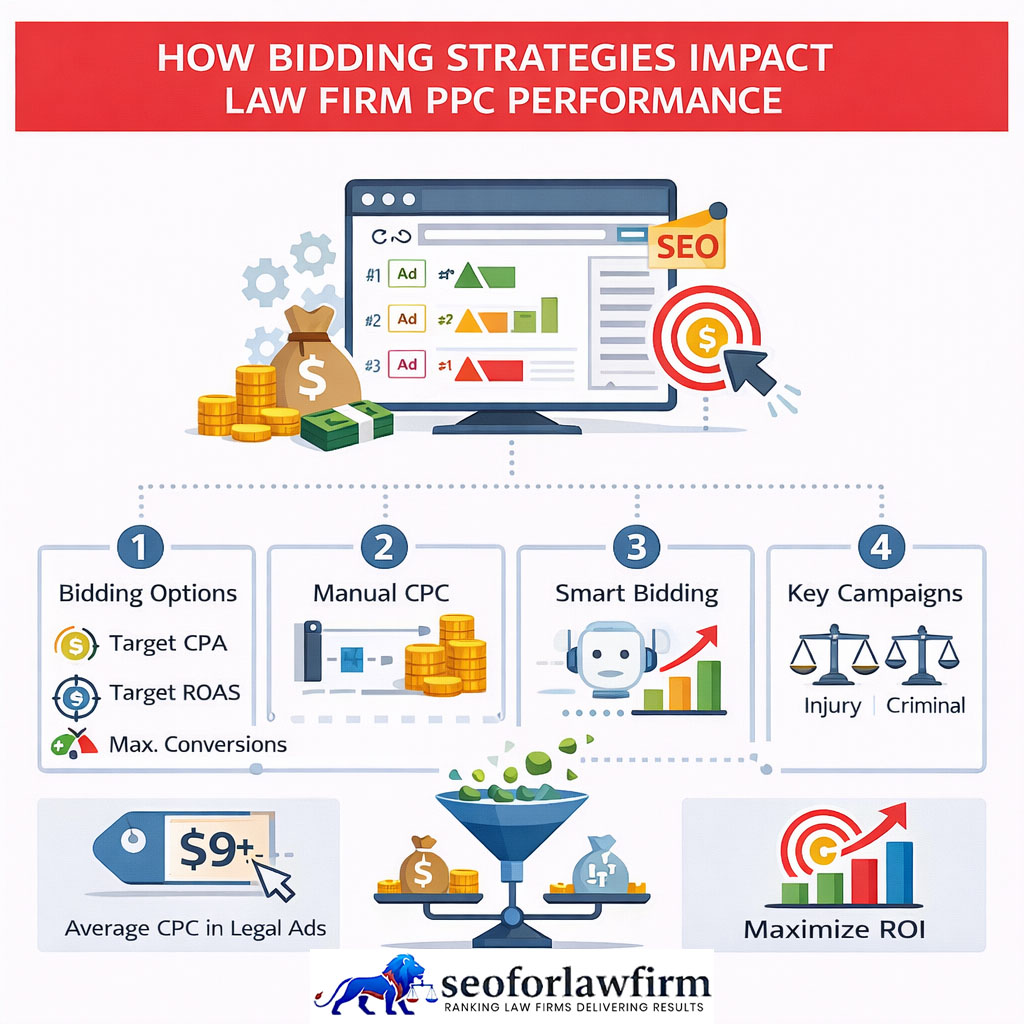
Bidding strategies affect law firm PPC performance by controlling how aggressively each campaign competes in advertising auctions and which business outcome the platform prioritizes. A PPC bidding strategy for lawyers aligns the campaign objective with qualified-lead volume, signed-case data, practice-area economics, available budget, and campaign maturity. Google Search campaigns use manual or automated bidding to pursue objectives such as click volume, conversion volume, cost per acquisition, conversion value, and return on advertising spend. Local Services Ads use bidding approaches such as Maximize Leads, target cost per lead, and manual maximum cost per lead, with bids, budget, responsiveness, reviews, and other quality signals influencing performance.
A study by Shuai Du, Qinglai Su, Xi Zhang, and Xiaofei Zheng from the University of Washington, Harbin Institute of Technology, and Tianjin University titled “Bidding for Multiple Keywords in Sponsored Search Advertising: Keyword Categories and Match Types” in 2017 found that keyword category and match type affected click-through rate, conversion rate, CPC, sales, profit, and ROI, supporting differentiated bidding across keyword groups. Law firms must therefore connect each bidding strategy with qualified leads, consultations, signed matters, acquisition costs, case value, and return on advertising spend rather than optimize every keyword toward the same objective.
Which Keywords Work Best for Lawyer PPC Campaigns?
The strongest PPC keywords for lawyers combine a specific legal service, clear hiring intent, and a relevant geographic market. Long-tail keywords usually provide stronger qualification signals than broad terms such as “lawyer” because the query identifies the case type, location, or desired action. Commercial modifiers such as attorney, lawyer, law firm, consultation, hire, near me, city, county, case type, charge type, and injury type help distinguish attorney-hiring searches from general legal-information searches.
Practice-specific queries such as “truck accident lawyer Houston,” “DUI defense attorney Chicago,” “divorce lawyer consultation Miami,” “probate attorney Dallas,” “employment discrimination lawyer Los Angeles,” and “motorcycle accident attorney near me” connect the legal problem with service intent. Keyword research must also separate informational queries from commercial queries because “what is comparative negligence” seeks an explanation, whereas “comparative negligence lawyer Houston” expresses legal-service intent.
The table below shows how keyword specificity changes legal search intent and likely lead qualification.
| Keyword | Intent Precision | Likely Qualification |
| lawyer | Very low | Mixed intent with limited practice-area or location context |
| injury lawyer | Low | Broad injury-service intent |
| motorcycle accident lawyer | Medium | Defined legal service and case type |
| motorcycle accident lawyer Dallas | High | Defined case type combined with a geographic market |
| motorcycle accident lawyer consultation Dallas | Very high | Legal service, location, and immediate consultation intent |
How Do Negative Keywords Reduce PPC Waste?
Negative keywords prevent Search Ads from appearing for queries containing irrelevant words or phrases, reducing spend on searches that do not match the firm’s client criteria.
Google defines a negative keyword as a keyword that prevents an ad from triggering for an excluded phrase.
Listed below are 17 examples of negative-keyword categories law firms must review according to their business model.
- Jobs.
- Salary.
- Career.
- School.
- Degree.
- Definition.
- PDF.
- Template.
- Free.
- Pro bono.
- Legal aid.
- Course.
- Internship.
- Bar exam.
- Do it yourself.
- Reddit.
- Wikipedia.
A firm offering free consultations must not automatically exclude the word “free.” A legal-aid organization must not exclude “pro bono.” Negative-keyword strategy depends on the service model and qualification criteria.
Search-term reports need regular review because keyword matching evolves and actual user queries reveal waste that initial keyword research misses.
Why Do Lawyers Need Dedicated PPC Landing Pages?
Lawyers need dedicated PPC landing pages because ad-message relevance, landing-page usefulness, conversion efficiency, and intake clarity improve when the destination directly matches the search and advertisement.
Google includes landing-page experience as a component of Search campaign quality evaluation. Google evaluates relevance, usefulness, navigation, and consistency between the advertisement and destination.
A person clicking an advertisement for “Houston truck accident lawyer” must reach a truck-accident landing page rather than a generic home page.
Listed below are the 7 questions the landing page needs to answer.
- Does the firm handle this case type?
- Does the firm serve this location?
- Which attorney handles these matters?
- What action does the prospect take next?
- How quickly does the firm respond?
- What information does the firm need?
- What evidence demonstrates relevant experience?
Listed below are the 8 main elements of a law firm PPC landing page.
- Search-matched headline: State the legal service and relevant location accurately.
- Direct service explanation: Explain which matters the firm handles.
- Attorney credibility: Identify attorneys, credentials, and relevant professional experience.
- Clear consultation action: Present the primary phone number or form without forcing unnecessary navigation.
- Mobile-first form: Request enough information to qualify the inquiry without creating excessive friction.
- Trust evidence: Present reviews, professional credentials, case experience, or results with appropriate qualification and compliance review.
- Fast performance: Remove unnecessary scripts, oversized media, and interface elements that delay contact.
- Consistent ad messaging: Ensure the promise in the advertisement matches the information on the destination page.
Home-page traffic forces the prospect to find the relevant service again after already expressing that service through the search query.
How Should Lawyers Use Geographic Targeting in PPC?
Lawyers should use geographic targeting to concentrate advertising on jurisdictions and service areas where the firm accepts clients.
Google Ads supports countries, regions, cities, radius targeting, and other geographic options. Google also distinguishes physical presence from location interest.
Google’s default location setting generally includes people physically in, regularly in, or showing interest in the target area. Advertisers that need tighter geographic control have the option to target people likely to be physically present or regularly present in the selected location.
A law firm serving only Texas therefore needs to review whether a campaign unintentionally reaches a person physically located in another state who merely searched for Texas information.
Listed below are the 6 geographic controls law firms must review.
- Target states where attorneys provide the advertised service.
- Separate high-cost metropolitan markets when performance differs.
- Exclude jurisdictions the firm does not serve.
- Review Presence versus Presence-or-Interest settings.
- Analyze geographic performance reports.
- Match landing-page language with the actual target jurisdiction.
Google states that location targeting relies on multiple signals and does not achieve 100% geographic accuracy, so actual location reports require ongoing review.
How Should Lawyers Track PPC Leads and Signed Cases?
Lawyers should track PPC leads and signed cases by connecting each advertisement, keyword, campaign, landing page, inquiry, consultation, retainer, accepted matter, and revenue outcome within one attribution process. Raw lead volume does not establish campaign quality because a campaign with fewer inquiries can produce more qualified leads and signed matters. For example, a campaign generating 20 leads and five signed cases from $8,000 in spend produces a $1,600 cost per signed case, whereas a campaign generating 40 leads and two signed cases from the same spend produces a $4,000 cost per signed case.
Google Ads phone-call conversion tracking connects qualifying calls with campaigns, ad groups, advertisements, and keywords, while offline conversion measurement connects later business outcomes with earlier advertising interactions. A law firm CRM must return downstream client statuses to the advertising measurement system so campaign optimization reflects qualified and retained matters rather than lead volume alone.
Listed below are the 9 PPC conversion stages law firms must track.
- Click: A click records the user’s interaction with the advertisement. The click identifies initial advertising engagement but does not establish lead quality or client value.
- Inquiry: An inquiry records a phone call, form submission, chat, or other contact initiated after the advertising interaction. The law firm must connect the inquiry with the originating campaign, keyword, advertisement, and landing page.
- Qualified Lead: A qualified lead represents a prospective client whose legal issue, jurisdiction, timing, and case characteristics match the firm’s intake criteria. Qualification separates viable matters from spam, vendors, wrong numbers, unsupported services, and out-of-jurisdiction inquiries.
- Consultation Booked: A consultation booking records a qualified prospect who schedules an attorney or intake appointment. The booking stage shows whether the intake process moves viable leads toward legal evaluation.
- Consultation Attended: Consultation attendance confirms that the prospective client completed the scheduled discussion. Attendance data distinguishes booked appointments from cancellations and no-shows.
- Retainer Sent: A retainer sent records the point at which the firm offers representation and provides an engagement agreement. The stage indicates that the matter passed the firm’s legal and business acceptance criteria.
- Retainer Signed: A signed retainer confirms that the prospective client accepted the engagement terms. The signed agreement provides a stronger PPC outcome than calls, forms, or consultation bookings.
- Case Accepted: Case acceptance records the matter as an active client engagement after required conflict, qualification, and onboarding procedures. The CRM must connect the opened matter with its original PPC source.
- Revenue Collected: Revenue collected measures the financial value generated from the retained matter. This stage allows the law firm to compare advertising spend with actual case revenue, gross profit, and return on advertising spend.
Law firms must also return downstream CRM statuses such as qualified case, consultation completed, retainer signed, and matter opened into PPC attribution workflows. These statuses allow campaign decisions to prioritize signed cases and financial outcomes instead of inexpensive but low-quality leads.
How Do Law Firms Calculate PPC ROI?
Law firms calculate PPC ROI by comparing advertising and management costs with the gross profit attributed to clients acquired through the campaign.
Use the following formula.
PPC ROI = ((Gross profit attributed to PPC − Total PPC cost) ÷ Total PPC cost) × 100
Listed below are the 8 total PPC costs to calculate.
- Media spend.
- PPC management fees.
- Landing-page production.
- Call-tracking cost.
- Analytics software.
- Creative production.
- Intake technology.
- Agency fees directly attributable to the campaign.
Listed below are the 4 acquisition metrics Law firms also need.
- Cost per Lead = Ad Spend ÷ Leads
- Cost per Qualified Lead = Ad Spend ÷ Qualified Leads
- Cost per Consultation = Ad Spend ÷ Consultations
- Cost per Signed Case = Ad Spend ÷ Signed Clients
Cost per signed case carries more business meaning than CPC.
How Do Law Firms Improve PPC Conversion Rates and Lower Cost per Lead?
Law firms improve PPC conversion rates and lower cost per lead through tighter search targeting, negative keywords, stronger advertisement relevance, dedicated landing pages, geographic control, fast intake, and downstream conversion data.
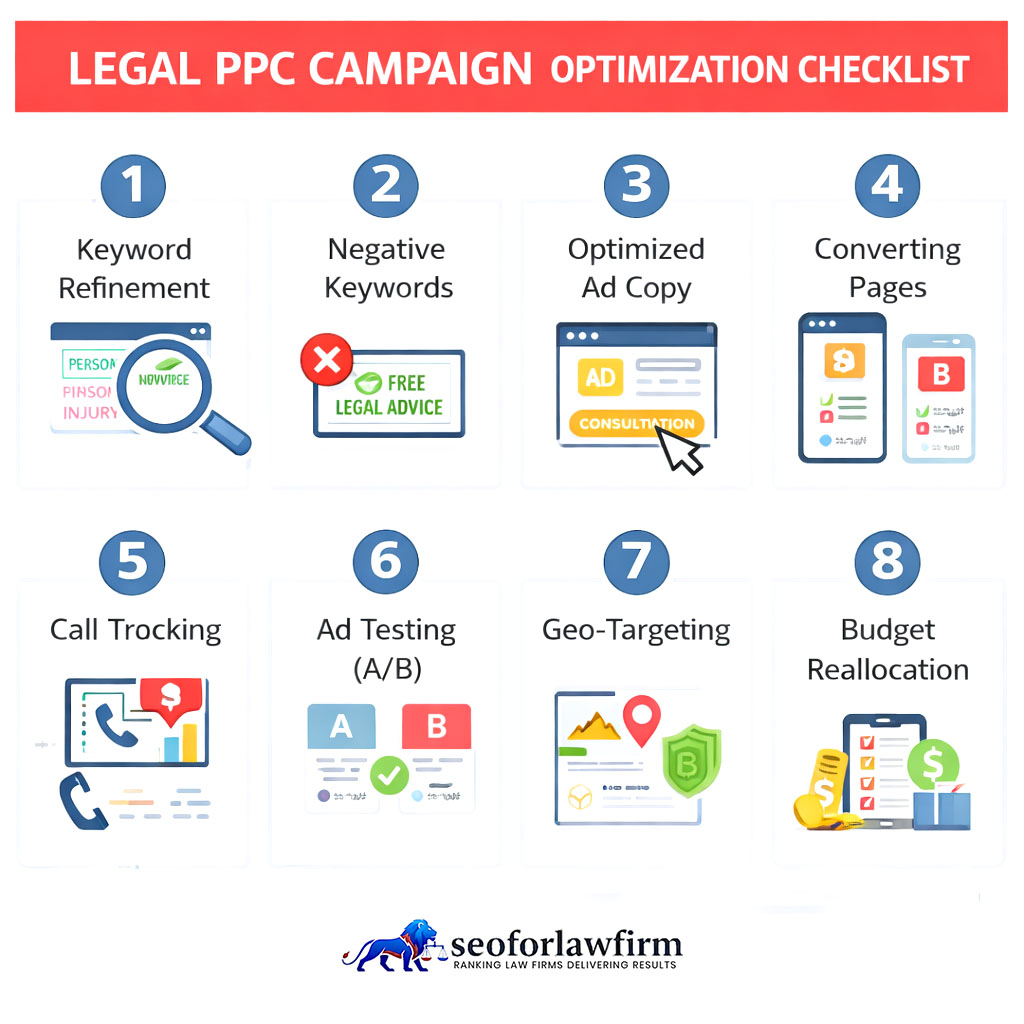
Listed below are the 8 PPC optimization steps law firms must use to improve lead quality and acquisition efficiency.
- Refine keyword intent: Shift spending toward searches connected with actual legal representation.
- Expand negative keywords: Remove education, employment, research, and irrelevant service queries.
- Align advertisement and search language: Match the user’s legal problem without repetitive keyword stuffing.
- Use dedicated landing pages: Send each major case type to the page that directly addresses that case.
- Reduce mobile friction: Simplify calls, forms, and appointment requests.
- Restrict geographic waste: Exclude jurisdictions and locations outside the firm’s market.
- Measure qualified outcomes: Track consultations and signed clients rather than treating every form as equal.
- Reallocate budget according to retained-case economics: Increase spending on campaigns producing profitable clients.
Which Bidding Metrics Matter Most for Law Firms?
The PPC metrics that matter most for law firms are impression share, CPC, conversion rate, qualified-lead rate, cost per qualified lead, consultation rate, signed-case rate, cost per signed client, and revenue attribution.
Listed below are the 9 PPC metrics law firms must use when evaluating campaign performance.
- Impression Share: Shows how the advertisement appears relative to eligible opportunities.
- Click-Through Rate: Measures the percentage of impressions producing clicks.
- Cost per Click: Measures advertising cost for each click.
- Conversion Rate: Measures how many clicks produce the campaign’s defined conversion.
- Cost per Lead: Measures spend required to generate a recorded inquiry.
- Qualified-Lead Rate: Measures the percentage of inquiries matching the firm’s case criteria.
- Consultation Rate: Measures how many qualified prospects schedule or complete consultations.
- Signed-Case Rate: Measures how many leads become retained clients.
- Cost per Signed Case: Measures total advertising spend required to acquire a client.
A campaign with a higher CPC frequently produces stronger economics when those clicks create a substantially higher signed-case rate.
What Are the Best PPC Budgeting Strategies for Lawyers?
The best PPC budgeting strategies for lawyers allocate spend according to case value, client eligibility, market competition, conversion data, and acquisition profitability.
Listed below are the 8 PPC budgeting practices lawyers must apply.
- Set a defined monthly and average daily budget.
- Separate practice-area budgets.
- Separate materially different geographic markets.
- Calculate the maximum acceptable cost per signed case.
- Reserve testing budget for new keywords and advertisements.
- Limit spend on queries without qualification evidence.
- Feed downstream conversion data into optimization.
- Increase budgets only after sustained profitable case acquisition.
A $20,000 monthly budget does not represent an aggressive or conservative amount without case-value context.
A personal injury firm earning $20,000 in expected gross profit from a retained case has different allowable acquisition economics from an estate-planning firm selling a $2,000 engagement.
Which Law Firms Benefit Most From PPC?
Law firms with urgent client demand, high-intent legal searches, sufficient case value, competitive geographic markets, and responsive intake systems benefit most from PPC advertising.
Listed below are 5 law firm categories with strong paid-search intent.
- Personal Injury Firms: Accident victims search immediately after collisions, injuries, or insurance disputes.
- Criminal Defense Firms: Arrest, DUI, bail, and criminal-charge searches frequently involve urgent representation needs.
- Family Law Firms: Divorce, custody, and domestic legal issues produce high-intent local searches.
- Immigration Firms: Visa, removal, citizenship, asylum, and status questions create defined service searches.
- Estate Planning Firms: Wills, trusts, probate, and estate administration create commercially valuable local searches with lower urgency than criminal or injury matters.
PPC economics still depend on geography, competition, case value, intake capacity, and firm differentiation.
How Do PPC Strategies Differ for Personal Injury and Family Law?
Personal injury PPC focuses more heavily on urgent high-value searches and expensive auctions, while family law PPC places greater emphasis on consultation intent, trust, privacy, and narrower service qualification.
The table below shows the main PPC differences between personal injury and family law campaigns.
| Dimension | Personal Injury PPC | Family Law PPC |
| Common intent | Immediate representation after injury | Divorce, custody, support, or related consultation |
| CPC environment | Extremely high in major markets | High but generally below extreme PI terms |
| Conversion urgency | Very high | Medium to high |
| Case qualification | Injury, liability, jurisdiction, insurance | Matter type, jurisdiction, conflict, financial fit |
| Main CTA | Call or request case evaluation | Schedule confidential consultation |
| Landing-page emphasis | Accident type, liability, experience, fast intake | Privacy, attorney experience, process, consultation |
| Remarketing sensitivity | Injury/health circumstances create policy concerns | Relationship hardship creates policy concerns |
Are Google Ads and Google AdWords Different for Lawyers?
No, Google Ads and Google AdWords are not different platforms for lawyers. Google AdWords was the former name of Google’s advertising platform. Google changed the Google AdWords brand to Google Ads in 2018 as the platform expanded beyond keyword-based search advertising.
Law firms now use Google Ads for search campaigns, display advertising, video advertising, remarketing, and other paid advertising formats. Current legal marketing content must use the term Google Ads rather than Google AdWords.

How Is PPC Different From SEO for Law Firms?
PPC differs from SEO because PPC purchases advertising exposure through auctions, while SEO develops unpaid search visibility through website relevance, content, local signals, links, and technical accessibility.
The table below shows how PPC and SEO differ for law firms.
| Dimension | PPC | SEO |
| Visibility speed | Immediate after campaign approval and auction eligibility | Develops over time |
| Primary cost | Advertising spend plus management | Content, technical, local, and authority investment |
| Traffic stops after spending ends | Yes | Existing rankings remain subject to competition and updates |
| Search placement | Sponsored | Organic and local |
| Keyword control | Direct campaign targeting | Search-engine ranking systems determine visibility |
| Testing speed | Fast | Slower |
| Main measurement | CPC, CPL, signed cases, ROAS | Rankings, organic leads, retained cases, ROI |
| Best use | Immediate demand capture | Long-term search acquisition |
PPC and SEO work together when paid-search data identifies valuable search intent, and SEO develops durable organic coverage around proven client needs.
What Are the Best Practices for Law Firm PPC?
The best practices for law firm PPC are precise keyword targeting, dedicated landing pages, signed-case tracking, geographic restriction, negative keywords, compliant advertisement copy, controlled bidding, and intake optimization.
Listed below are the 10 law firm PPC practices that directly support lead quality and budget efficiency.
- Target case-specific and location-specific search intent.
- Group closely related keywords and services together.
- Build negative-keyword lists before launch.
- Send paid traffic to dedicated landing pages.
- Keep ad claims accurate and verifiable.
- Target only markets and jurisdictions the firm serves.
- Track calls, forms, consultations, and signed cases.
- Connect CRM outcomes with advertising data.
- Review search terms and geography regularly.
- Scale budgets according to cost per retained client.
Google requires advertisers to comply with applicable laws and regulations in every targeted location in addition to Google Ads policies. Legal advertising also remains subject to applicable state bar advertising rules.
Misrepresentation policies prohibit misleading claims about identity, affiliations, qualifications, or services.
Listed below are the 10 compliance review Law firms need before using claims.
- Best lawyer.
- Specialist.
- Guaranteed result.
- Guaranteed settlement.
- Number 1 attorney.
- Success rate.
- Case-value claims.
- Comparative superiority.
- Professional certification.
- Competitor names.
Where Do Law Firms Get Professional PPC Management?
SEOForLawFirm is a specialized legal marketing provider that gives law firms structured PPC management across keyword research, Google Ads, Local Services Ads, geographic targeting, landing pages, conversion tracking, call attribution, CRM integration, signed-case reporting, budget forecasting, and bidding strategy. Law firms also obtain professional PPC management from legal marketing agencies, paid-search specialists, in-house media buyers, and full-service digital marketing firms with documented legal advertising experience.
Professional PPC management services for lawyers connect advertising spend with qualified inquiries, consultations, retained matters, and case revenue rather than impressions and clicks alone. A qualified PPC provider understands legal practice areas, calculates target cost per signed case, selects conversion events for bidding algorithms, connects CRM outcomes with Google Ads, reviews search terms regularly, controls geographic targeting, preserves the law firm’s ownership of advertising accounts and campaign data, and reports meaningful monthly performance metrics. Search Ads capture high-intent legal queries, Local Services Ads generate eligible local leads, social advertising expands paid reach, keyword specificity controls intent, landing pages convert advertising traffic, geographic targeting reduces irrelevant spend, and signed-case attribution measures whether the campaign produces profitable legal matters.
What Common PPC Mistakes Do Lawyers Make?
The most common lawyer PPC mistakes waste budget through broad targeting, weak landing pages, poor geographic controls, incomplete conversion tracking, and optimization around lead quantity instead of retained clients.
Listed below are the 10 PPC mistakes law firms must avoid.
- Bidding on overly broad searches: Terms such as “lawyer” mix numerous unrelated practice areas and client intents.
- Ignoring negative keywords: Unqualified research, career, education, and free-service searches consume budget.
- Sending traffic to the homepage: Generic destinations weaken message continuity and require the prospect to restart navigation.
- Tracking every lead as equal: Spam, vendors, existing clients, job seekers, and unsupported cases distort campaign optimization.
- Stopping attribution at the form submission: Lead tracking without retained-case data hides actual profitability.
- Using unrestricted geographic settings: Campaigns spend money on people outside the firm’s jurisdiction or target market.
- Scaling before sufficient conversion evidence exists: Larger budgets magnify an inefficient campaign.
- Ignoring landing-page performance: Weak relevance, slow pages, and complex forms reduce conversion efficiency.
- Making unsupported advertising claims: Promotional language creates platform, legal, and professional-compliance risk.
- Leaving campaigns unattended: Search terms, competitors, CPCs, geographic performance, and conversion quality change over time.
Should Law Firms Track Clicks or Signed Cases?
Yes, law firms should track signed cases as the primary business outcome while retaining impressions, clicks, leads, qualified leads, and consultations as diagnostic metrics. Impressions measure advertising visibility, clicks measure engagement, leads measure inquiry generation, qualified leads measure case fit, consultations measure intake progression, signed clients measure client acquisition, and revenue measures financial return.
The measurement sequence follows Impression → Click → Lead → Qualified Lead → Consultation → Signed Client → Revenue. Law firms must optimize PPC campaigns toward the deepest conversion event that the tracking system records reliably. Google’s enhanced conversions for leads and offline conversion measurement connect online advertising interactions with later outcomes such as qualified cases, signed retainers, and revenue.